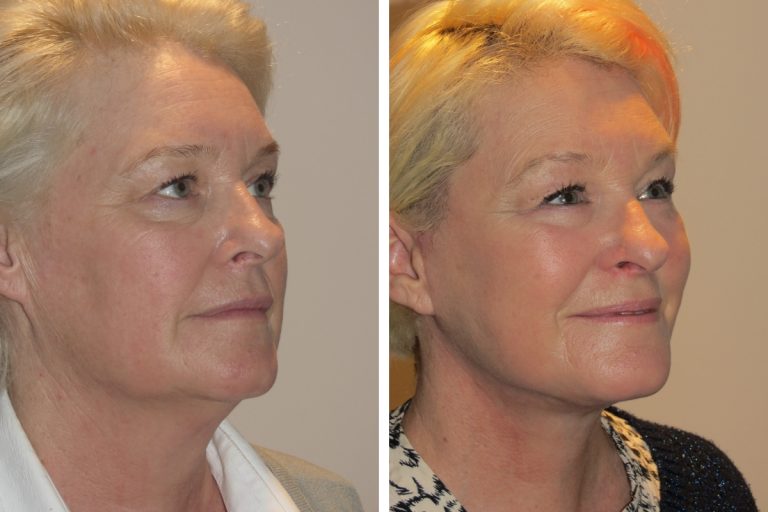
Real Patient Results How much does it cost? Book a Consultation Read our FAQs
Woollahra Sydney . Wollongong NSW

Understanding facelift (rhytidectomy) surgery
Facelift surgery, otherwise known as a Meloplasty or Rhytidectomy is a surgical procedure commonly performed on patients who wish to address the appearance of certain facial features.
The visible changes associated with ageing are a net result of anatomical alterations that occur in all layers of the face. This includes bone loss, loss of skin elasticity, and loss of structure of our facial soft tissue. There are a variety of lifestyle factors that can contribute to your skin quality such as being overweight, sun damage, and smoking.
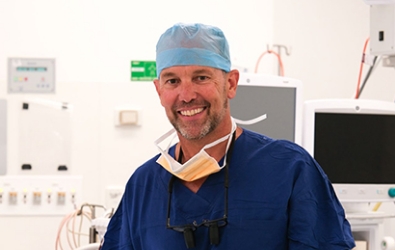
Over time, our understanding of the complex facial structure has grown, as have our surgical abilities to reverse them. Dr Jeremy Hunt offers a range of facelift (rhytidectomy) procedures. Using techniques such as the deep plane facelift (rhytidectomy), Dr Hunt avoids unnecessary tightening of the facial skin that is commonly used to typify older methods.


Why Patient Might Consider Facelift (Rhytidectomy) Surgery
There are many reasons why a patient might consider undergoing these procedures such as:
- Addressing loose or saggy skin
- Combatting wrinkles and fine lines
- Improved aspect of the face
- Altering the contours of the face
Types of face lifts (rhytidectomies)
Dr Jeremy Hunt uses a number of techniques to offer several different types of facelift (rhytidectomy) procedures depending on your aesthetic goal. Each facelift (rhytidectomy) comes with its own set of risks, downtime, and recovery phases. Facelift (rhytidectomy) surgery aims to remove sagging skin and revert the visible signs of the ageing process.
When facelifts (rhytidectomy) were first introduced to plastic surgery, an incision would be made onto the face and neck and the skin would be pulled back. However, this “skin-only” wasn’t reliable and so over time plastic surgeons were able to develop new techniques by introducing mini facelift (rhytidectomy) procedures, the deep plane facelift (rhytidectomy), and a plethora of other facelift (rhytidectomy) techniques.
Two of the most common basic facelift (rhytidectomy) techniques are explained below:
Mini-Facelift (Rhytidectomy)
The mini facelift (rhytidectomy) is a modified version of traditional facelift (rhytidectomy) surgery. During your mini facelift (rhytidectomy), your plastic surgeon uses limited incisions with an aim to lift the fat pads of the face and tighten facial muscles in the lower midface and address jawline contour.
The mini facelift (rhytidectomy) has proved to be a more common cosmetic procedure for younger patients. Candidates for a mini facelift (rhytidectomy) are those who are younger and display minimal photoaging and wrinkles and have moderate elasticity of their facial tissues.
Facelift (Rhytidectomy) Surgery – How Is It Performed
Facelift (rhytidectomy) surgery is performed by following a series of steps. Although a cosmetic surgery, facelift (rhytidectomy) surgery is still somewhat invasive, and so requires the use of an appropriate treatment room and anaesthesia.

Step 1 –
Anaesthesia
Prior to your surgery, and assuming that all preoperative checks have been completed, you will be met by an anesthetist who will optimise a medication regime to put you at ease throughout your surgery. Facial surgery typically requires the use of general anaesthesia, meaning that you will be put to sleep.

Step 2 –
Incisions
Once you are under anaesthesia, your surgeon will commence your facelift (rhytidectomy) surgery by making multiple small incisions. The depth and size of these incisions vary depending on the degree of outcome which you are expecting and the facelift (rhytidectomy) procedure you have decided to undergo.
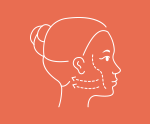
Traditional incisions begin at the hairline around the temples, continue around the natural contour behind the ear, and sometimes under your chin (if you are having a neck lift).

Step 3 –
The Lift
Once the incisions are complete, Dr, Hunt will identify the superficial muscular aponeurotic system (SMAS), which is the underlying musculature of the face that is lifted. Going under this SMAS layer is entering the “ deep plane” and this is where the SMAS layer, fat pads and muscle are lifted from. This upward and outwards movement aims to accentuate your jawline, address jowls and deep marionette lines at the corner of the mouth, and deep nasolabial folds that run from the base of the nose down past the corner of the mouth. The cheek fat pad will be elevated on the cheek bone, aiming to achieve an overall natural-looking definition to your face.
The tightening is done on the deeper layers of the skin so as not to create an obvious “skin-tight” look.

Step 4 –
Suturing Incisions
Once the skin, and depending on your procedure, the facial muscles have been tightening, Dr Hunt will secure it in place, removing excess skin during the process. A drain may be placed to prevent the build-up of fluid and reduce pressure on the incision sites. The incisions will then be sutured shut.